

TR-069 vs TR-369: Migration Guide for ISPs
By Guy Migdal
Last updated: September 2026
Broadband subscribers increasingly judge their Internet Service Provider not only by connection speed, but by the performance of their in-home Wi-Fi. Wi-Fi 6/7, Mesh networks and growing numbers of connected devices require faster troubleshooting, richer telemetry, and more flexible device management.
For nearly two decades, TR-069 CWMP has provided ISPs with a reliable standard for remotely managing customer premises equipment (CPE). TR-369 USP (User Services Platform) extends those capabilities with persistent communication, richer telemetry and a multi-controller architecture.
Moving to TR-369 does not require replacing TR-069 overnight. ISPs can run both protocols during a phased migration and introduce USP according to device readiness and business priorities.
What Is TR-069 CWMP?
TR-069, also known as CWMP (CPE WAN Management Protocol), is a Broadband Forum standard for remotely managing CPE such as broadband gateways and routers.
Through an Auto Configuration Server (ACS), ISPs use TR-069 for device provisioning, configuration, firmware management, diagnostics and ongoing CPE management.
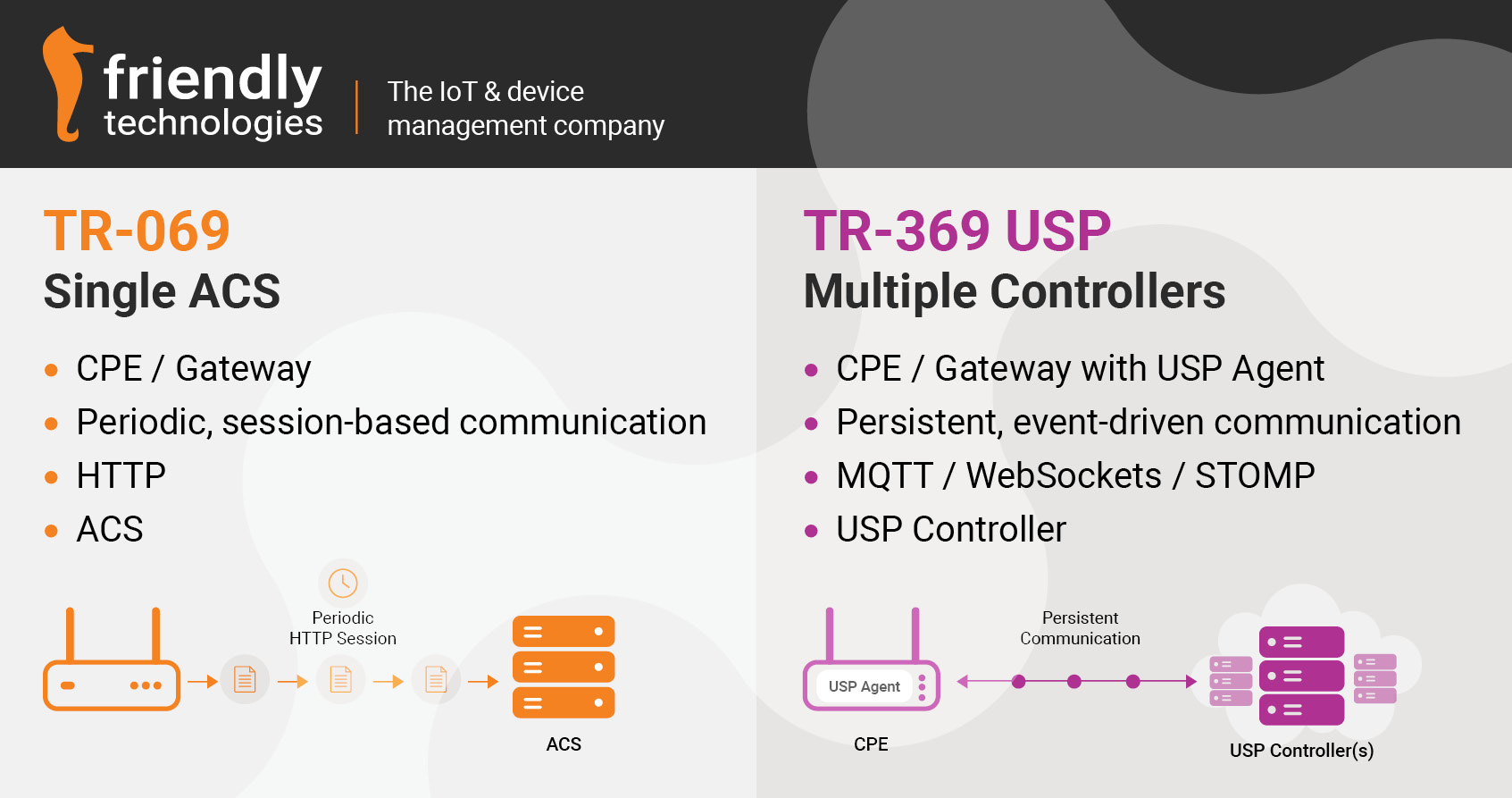
TR-069 uses session-based communication between the CPE and ACS. It remains important for existing broadband deployments, but its architecture predates today’s requirements for persistent communication, high-frequency telemetry, and multiple controllers.
TR-069 vs TR-369: Key Differences
| Capability | TR-069 CWMP | TR-369 USP |
|---|---|---|
| Communication | Session-based | Event-driven |
| Typical transport | HTTP | MQTT, WebSockets, STOMP |
| Device communication | Periodic sessions | Persistent, low-latency |
| Architecture | Single ACS | Multi-controller, multi-agent |
| Telemetry | Primarily request/status-based | High-frequency Bulk Data telemetry |
| Access control | More limited | Granular Role-Based Access Control |
| Data model | TR-181 supported | TR-181 supported |
| Typical use | Provisioning and CPE management | Provisioning, Real-time management, telemetry and advanced services |
What Is TR-369 USP?
TR-369 USP is the Broadband Forum’s modern device-management architecture. It uses event-driven messaging and Message Transfer Protocols such as MQTT, WebSockets and STOMP to support persistent, low-latency communication between devices and controllers.
Its multi-controller, multi-agent architecture allows authorized provisioning systems, Wi-Fi optimization tools, support applications and subscriber-facing services to interact with the same gateway and access the functions relevant to their role.
What Are the Benefits of TR-369 for ISPs?
TR-369 gives support teams faster access to device states and parameters, accelerating troubleshooting and helping reduce Average Handling Time and unnecessary truck rolls.
While legacy TR-069 can query basic network metrics, Bulk Data telemetry decouples metric collection from core ACS operations. By streaming parameters like packet error rates, channel utilization, and signal-to-noise ratios directly to dedicated analytics collectors, operators can gather data far more frequently and at scale. This persistent data flow allows operators to analyze historical trends and spot recurring issues without overloading the central management platform.
Granular Role-Based Access Control (RBAC) and multi-controller support also create a foundation for managed and value-added services, including:
- Home cybersecurity services
- Advanced parental controls
- Self-service Wi-Fi management
- Proactive Wi-Fi optimization
- Managed smart-home services
This gives ISPs an opportunity to use device-management infrastructure not only for provisioning and support, but also to deliver additional subscriber services.
How to Migrate from TR-069 to TR-369
A practical TR-369 migration can be divided into three steps.
1. Add the TR-369 Management Layer
Introduce a USP Controller and establish communication through MTPs such as MQTT, WebSockets or STOMP. Existing TR-069 management continues operating alongside the new environment.
2. Enable Compatible CPE
TR-069 and TR-369 both support the standardized TR-181 data model. Where existing hardware and firmware allow it, a firmware update can add a USP Agent alongside the existing CWMP client. Whether this is possible depends on the capabilities of each device.
3. Run TR-069 and TR-369 Together
ISPs can keep provisioning and WAN configuration on TR-069 while moving telemetry, Wi-Fi analytics and real-time support functions to TR-369. As older CPE reaches its normal end of life, operators can progressively introduce more USP-enabled devices. This avoids a disruptive network-wide hardware replacement.
Why a Unified TR-069 and TR-369 Platform Matters
Friendly Technologies’ Unified Device Management platform supports TR-069 CWMP and TR-369 USP in the same management environment.
ISPs can continue managing their existing TR-069 CPE while introducing USP-enabled devices and services according to their operational priorities. This avoids separate management silos and allows migration to align with firmware upgrades and normal device replacement cycles.
TR-369 Migration FAQ
Is TR-369 replacing TR-069?
TR-369 extends device management beyond the traditional TR-069 architecture, but ISPs do not need to replace TR-069 immediately. Both protocols can operate side by side during a phased migration.
Can TR-069 and TR-369 run on the same network?
Yes. Operators can continue managing TR-069 devices while progressively introducing TR-369-enabled devices, controllers and services.
Do I need to replace my existing CPE?
Not always. Many active devices can be upgraded to USP via firmware updates. This allows them to connect to dedicated secondary controllers and data collectors, enabling you to take full advantage of high-frequency Bulk Data telemetry. Devices that cannot support a USP agent can remain under TR-069 management until their natural replacement cycle.
How long does a TR-369 migration take?
There is no single timeline. Migration can follow the installed CPE base, device capabilities, operational priorities, and normal hardware replacement cycles.
What are the main benefits of TR-369?
Key benefits include persistent low-latency communication, richer telemetry, multi-controller architecture, granular access control, and greater flexibility for advanced broadband and managed-home services.
Move to TR-369 at Your Own Pace
TR-369 migration does not require abandoning existing TR-069 infrastructure. A unified approach allows ISPs to protect existing CPE investments while progressively introducing real-time device visibility, richer analytics and new managed services.
Ready to explore your TR-369 migration strategy?
Explore Other Topics

Friendly IoT Device Management
One-IoT™ Device Management
IoT Application Enablement
Friendly Smart Home
Embedded Clients
Friendly LwM2M client
Friendly OMA-DM Client
Friendly Partners
Commercial Partners
Device Manufacturers
Resources
Blog & News
Glossary
Webinars
About Friendly Technologies
© 2026 Friendly Technologies. All rights reserved.