


TR-369 Migration: Keep TR-069 Workflows While Adding USP
By Guy Migdal
Last updated: November 2026
TR-369 migration does not require replacing your TR-069 architecture overnight. Operators can and should introduce USP gradually, keeping the provisioning processes and integrations that already work on TR-069 while adding new capabilities, such as real-time telemetry and monitoring, through USP. This lowers risk and lets each operator move at its own pace.
This article explains why the move to TR-369 matters for both operators and their subscribers, what risks make operators hesitate, and the approaches and tools, including dual-stack device management, that address these risks and make the transition manageable, from preparation to pilot and beyond. Friendly Unified Device Management brings these tools together in one platform, combining TR-069 ACS and USP Controller functions and managing compatible devices through both protocols at the same time.
Why Migrate to TR-369?
Subscribers judge their provider by how their home network performs, and Quality of Experience (QoE) is arguably the strongest factor in whether they stay or leave. TR-369, the User Services Platform (USP), gives operators the tools to protect it.
The most important TR-369 benefits start with Wi-Fi quality. USP supports event-driven telemetry, so operators can see Wi-Fi performance in real time, not only at the next scheduled session. That same visibility speeds up troubleshooting: support teams get current device data and diagnostics on demand, helping resolve issues on the first call and avoid unnecessary technician visits.
USP also opens the door to growth with a new architecture that allows multiple Controllers on the same device, making it easier to add managed services and partner applications. It runs over modern message transfer protocols such as WebSocket, MQTT, and STOMP.
TR-369, designed to coexist with TR-069, is where the Broadband Forum focuses on its ongoing development. New capabilities in the shared device data model are increasingly built with it in mind. TR-069, however, remains a supported standard but has not received a protocol amendment since 2018.
Because of that, the question for operators is no longer whether to migrate to TR-369, but how best to do it.
For a full comparison of the two protocols, see TR-069 vs TR-369: Migration Guide for ISPs.
Why TR-369 Migration Can Feel Risky
Most operators already run a TR-069 platform that is stable and proven, and hesitating to change it is a sensible reaction. To move forward, it helps to look at what drives that hesitation, one concern at a time.
First are the crucial processes operators depend on every day. Zero-touch provisioning, activation flows, configuration templates, and OSS/BSS integrations were built around the TR-069 ACS over many years and rebuilding them in one step is costly and puts service at risk.
The fleet adds another layer: some devices support USP and many do not, and with replacement cycles running for years, any plan must work seamlessly with both.
In addition, device support can be incomplete. On some gateway models, essential settings such as the ACS address and periodic inform interval are reachable only through TR-069, and on others, USP itself is configured through TR-069. For these devices, switching TR-069 off is not an option.
Finally, there is the transition itself. Managing each protocol on a separate platform doubles integration work, monitoring, and training, while a network-wide switchover puts subscriber experience at stake if anything goes wrong.
Each of these concerns has a practical answer, and addressing them is the key to a smooth transition to TR-369 and the new tools and capabilities it brings.
How Can Operators Introduce USP Without Losing TR-069 Workflows?
A successful migration is one where nothing that works today is switched off. Provisioning continues as usual, support teams keep their tools, and USP capabilities arrive alongside them, starting where they add the most value.
This is achievable today. USP was designed to coexist with TR-069, and both protocols use the same TR-181 device data model, which keeps changes to back-end systems smaller. In practice, the approach rests on three principles:
- Add, don’t replace: Introduce USP next to TR-069 rather than in place of it.
- Start focused: Begin with one defined use case, such as Wi-Fi telemetry or remote diagnostics.
- Expand in phases: Extend USP as devices, integrations, and teams are ready.
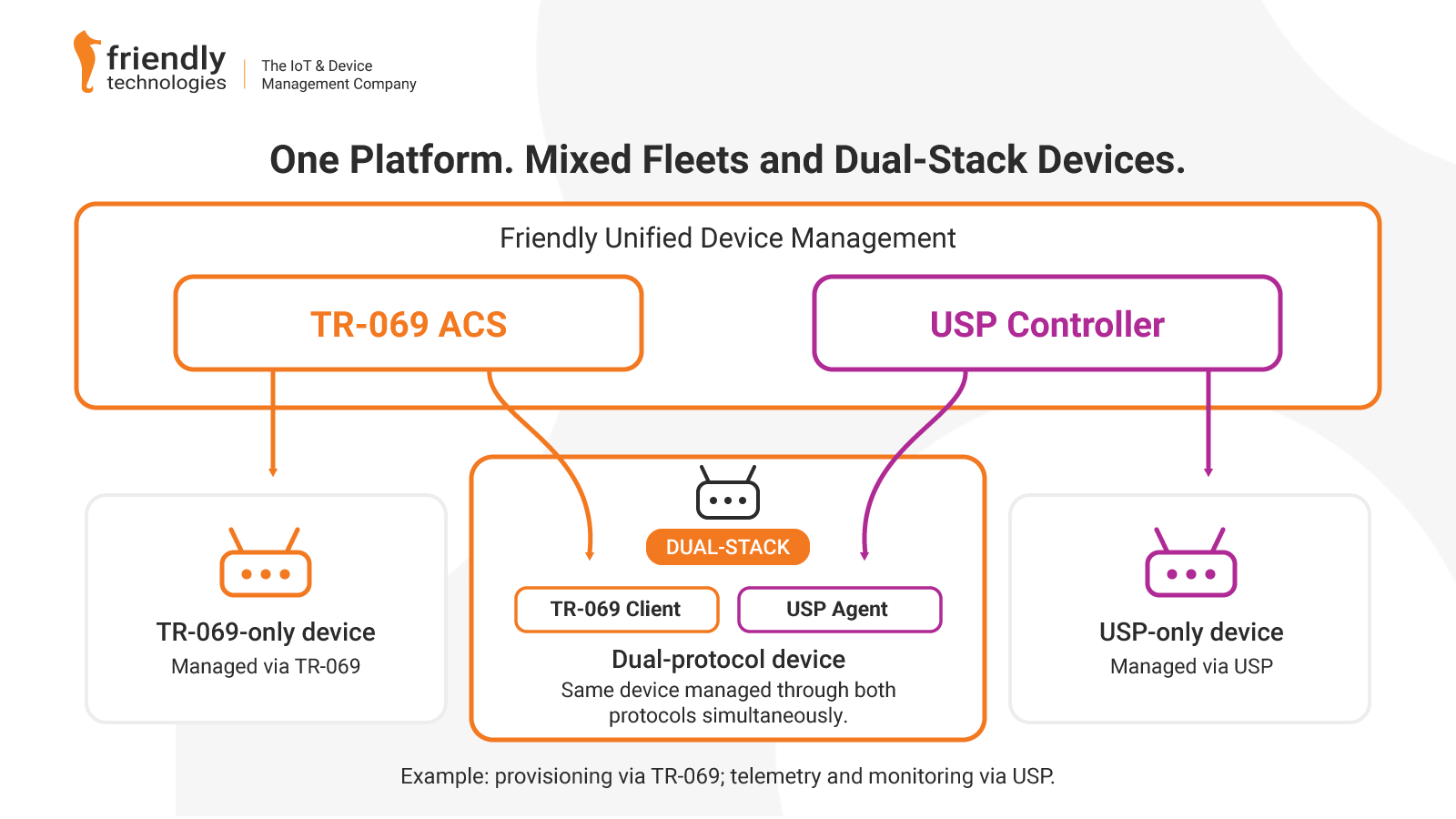
Two platform capabilities make the transition practical: managing a mixed fleet in one place and running both protocols on a single device at the same time (dual-stack device management).
Manage a Mixed Fleet from One Platform
In a mixed fleet, some devices are managed only through TR-069 and others only through USP. This is the reality for most operators, and it will remain so for years.
A unified platform that combines a TR-069 ACS and a USP controller manages both groups from one place, with one set of tools, integrations, and workflows. Older devices stay on TR-069 until they reach end of life, while new USP devices join the same environment.
Friendly Unified Device Management is built this way, combining TR-069 ACS and USP controller functions in a single platform.
Migration can then follow natural device replacement cycles instead of forcing an early hardware swap, and teams never have to run two separate management systems.
Dual-Stack Device Management: Run TR-069 and USP on the Same Device
A unified platform solves the challenge across the fleet. The harder challenge sits inside a single device.
A growing number of gateways already support both TR-069 and USP. Yet when a platform can manage each device through only one protocol at a time, operators face a difficult choice: stay on TR-069 and miss USP’s capabilities, or switch to USP and put established provisioning at risk. For devices where key settings are reachable only through TR-069, switching is not even possible.
Dual-stack device management solves this by delivering the benefits of both options. One compatible device is managed through TR-069 and USP at the same time, and each protocol is assigned to the responsibilities it handles best. A common allocation keeps provisioning and activation on TR-069, exactly as they run today, while telemetry and monitoring move to USP.
For operators, this delivers:
- Continuity: Established provisioning, activation, and back-office workflows stay untouched.
- Immediate value: USP visibility and diagnostics are available now, without waiting for a full migration.
- Full coverage: Devices with incomplete USP support remain fully manageable.
- A complete view for support: Agents can see the same subscriber device through both protocols.
- Control: The operator decides which functions to move to USP, and when.
Friendly Unified Device Management supports dual-stack device management. With it, operators can introduce USP on compatible devices while their TR-069 operations continue to run. Migration becomes a series of controlled steps rather than a single high-stakes switch.
What Must the Device, Platform, and Integrations Support?
Active USP management needs support on both ends of the connection: a USP Agent on the device and a USP controller on the platform. Device support comes from the equipment itself. USP Agents are usually delivered through vendor firmware, and the parameters each model exposes vary, so coverage should be confirmed for each model.
Integrations need clear ownership too. OSS/BSS, provisioning, and support systems must recognize devices managed through either protocol, and each function should be clearly assigned to one protocol.
The following table details what each device scenario requires.
| Scenario | Protocol responsibility | Prerequisites | Benefit |
|---|---|---|---|
| TR-069-only device | All management through TR-069 | TR-069 client on the device; TR-069 ACS on the platform | Existing operations continue unchanged |
| USP-only device | All management through USP | USP Agent on the device; USP controller on the platform | Full access to USP capabilities |
| Dual-protocol device, preparing for USP | TR-069 manages the device while USP is set up and tested | USP Agent in the device firmware; USP controller ready on the platform | Readiness without disruption |
| Dual-protocol device, active USP | Responsibilities split, e.g., provisioning on TR-069, telemetry on USP | Both clients active; platform running the ACS and controller together | New capabilities while existing workflows continue |
What Should Operators Test Before a Pilot?
A successful pilot must prove a single small-scale use case before it can be expanded.
Before the pilot, make sure you verify:
- Device identification across both protocols
- User roles and permissions
- The allocation of responsibilities between TR-069 and USP
- Telemetry accuracy and reporting frequency
- Behavior of northbound integrations and reporting
- Support workflows for agents handling pilot subscribers
Run the pilot with a defined subscriber group and success criteria agreed in advance. Then expand in phases, by device manufacturer and model, region, or service, as the results confirm readiness. Each phase builds the experience and confidence needed for the next.
How Will You Know the Migration Is Working?
A phased migration needs clear signals for when to move to the next phase. Consider some or all of these metrics:
- Functions migrated: Which management tasks now run on USP, and whether they perform as expected.
- Support outcomes: First-call resolution, average handling time, repeat contacts, and technician visits for the pilot group, compared with the rest of the fleet.
- Operational stability: Provisioning success rates and integration errors, confirming that existing TR-069 processes are unaffected.
When these metrics hold steady or improve, the next phase can begin. Step by step, operators gain the QoE advantages of USP without putting what already works at risk.
Ready to bring USP into your network without disrupting what works? Contact Friendly Technologies to discuss your device environment, dual-stack requirements, and a focused USP pilot.
Frequently Asked Questions
Can TR-069 and USP run on the same device at the same time?
Yes, if the device implements both a TR-069 client and a USP Agent, and the management platform supports both. Dual-stack device management lets operators assign to each protocol different responsibilities on the same device.
Do operators need to turn off TR-069 to use USP?
No. The Broadband Forum designed USP to coexist with TR-069. On some devices, certain settings are reachable only through TR-069, so keeping it active is necessary.
Can provisioning stay on TR-069 while telemetry moves to USP?
Yes. This is one of the most practical ways to start, because established activation workflows stay in place while USP adds real-time visibility. On devices that support both protocols, dual-stack device management makes this split possible.
What is the difference between a mixed fleet and a dual-stack device?
A mixed fleet contains separate devices, each managed through one protocol. A dual-stack device is a single device managed through both TR-069 and USP at the same time.
What is needed before piloting USP?
A USP Agent on the devices in scope, a USP controller on the platform, integrations that recognize USP-managed devices, and a clear decision on which protocol handles which function. Pre-pilot testing should confirm device identification, permissions, and telemetry behavior.
Friendly Unified Device Management helps operators introduce USP gradually while retaining established TR-069 operations.
Contact Friendly Technologies to discuss your device environment, dual-stack requirements, and a focused USP pilot.
Explore Other Topics

Friendly IoT Device Management
One-IoT™ Device Management
IoT Application Enablement
Friendly Smart Home
Embedded Clients
Friendly LwM2M client
Friendly OMA-DM Client
Friendly Partners
Commercial Partners
Device Manufacturers
Resources
Blog & News
Glossary
Webinars
About Friendly Technologies
© 2026 Friendly Technologies. All rights reserved.